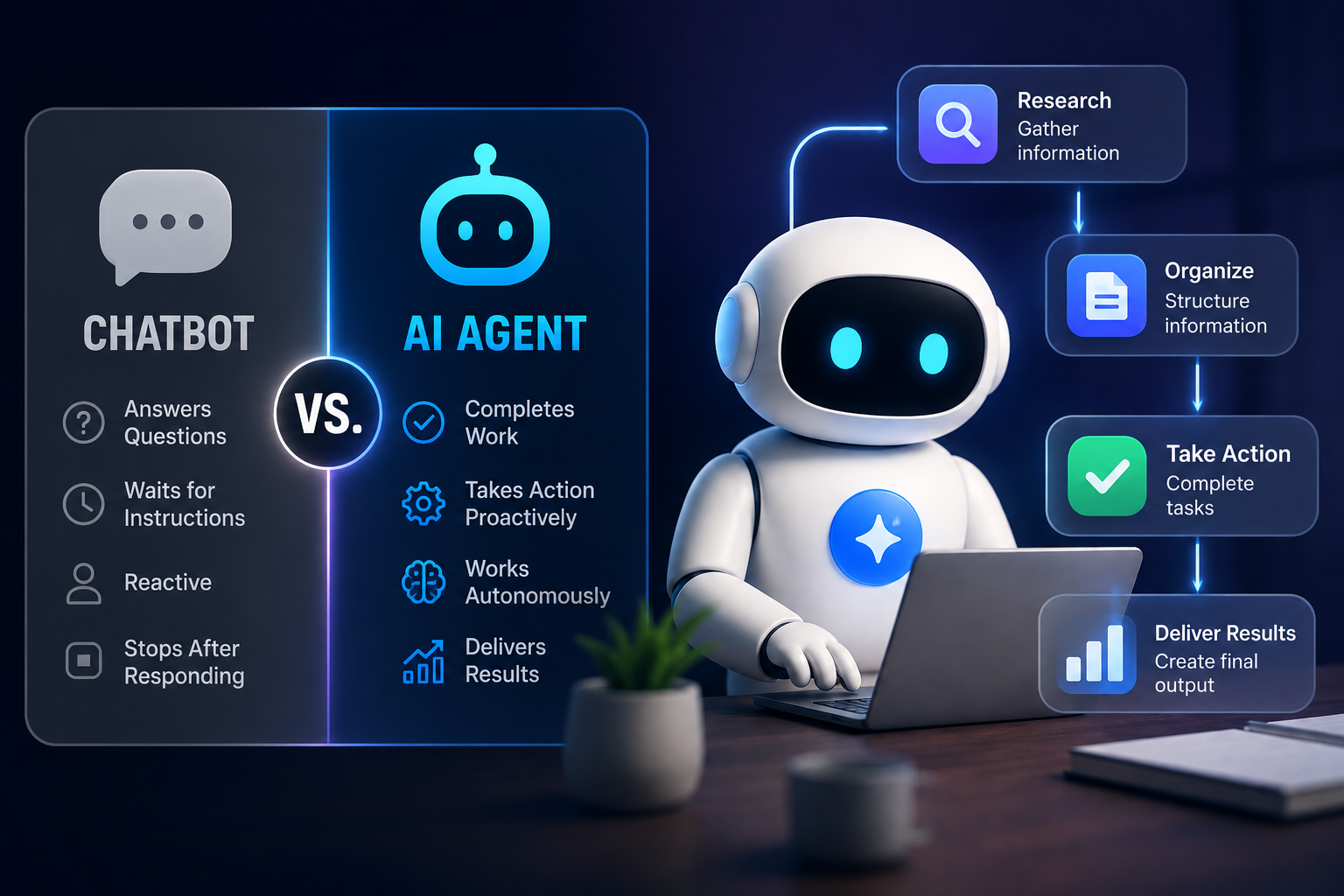
For the past couple of years, most people experienced AI through chat interfaces.
You type something.
The AI answers.
Then the conversation repeats again.
At first, that alone felt impressive.
But recently, AI started feeling different to me.
Not necessarily smarter in conversation.
More useful in an actual workflow.
That’s probably the biggest reason why people keep talking about AI agents lately.
They don’t just feel like chatbots with better answers.
They feel closer to systems that can actually help complete work.
Chatbots Usually Wait for Instructions
Most traditional chatbots are reactive.
They wait for users to tell them exactly what to do.
Write an email.
Summarize an article.
Explain a topic.
Translate a sentence.
The AI responds and stops there.
Even though the responses can be very good, the user still manages the entire process manually.
You still open tabs.
Still organize files.
Still move information around yourself.
That’s why older AI tools often felt impressive but oddly disconnected from real productivity.
AI Agents Feel More Involved in the Process
AI agents feel different because they try to participate in the workflow itself.
Instead of only generating text, they attempt to:
- organize information
- break tasks into steps
- connect tools
- maintain context
- and sometimes even complete actions automatically
That changes the experience quite a lot.
The AI starts feeling less like:
“a chatbot you ask questions to”
and more like:
“a system working alongside you.”
The Difference Becomes Obvious During Real Work
I think the difference becomes much clearer during actual work rather than casual conversations.
For example, imagine researching a topic manually.
Normally you might:
- search multiple websites
- compare information
- organize notes
- summarize findings
- and then create a final document
That process takes time and mental energy.
Modern AI systems increasingly try to reduce those repetitive steps.
Not perfectly.
But enough that the workflow starts feeling noticeably faster.
That’s where AI agents begin feeling fundamentally different from normal chatbots.
AI Is Slowly Moving From Conversation to Action
One thing I keep noticing lately is that AI companies are no longer focusing only on conversations.
The direction now seems much more focused on:
- workflows
- automation
- task completion
- productivity
- and system integration
That’s why recent updates from companies like:
feel different compared to older chatbot launches.
The industry no longer seems obsessed only with:
“Which AI sounds smartest?”
Now the bigger question feels more like:
“Which AI actually helps people get work done faster?”
AI Agents Reduce Friction
The biggest advantage I personally notice is reduced friction.
A lot of digital work involves small repetitive actions:
- opening tabs
- copying information
- formatting text
- rewriting content
- organizing notes
- switching between tools
Individually, those tasks are small.
But together they consume a surprising amount of time.
AI agents attempt to remove some of that friction.
And honestly, once you get used to faster workflows, older methods start feeling slower than they used to.
The Experience Feels Closer to a Real Assistant
For years, tech companies promised “AI assistants.”
But most assistants were fairly limited.
They could:
- answer simple questions
- set timers
- or perform basic commands
Modern AI agents feel closer to what many people originally imagined.
Not because they are fully autonomous yet.
But because they can increasingly:
- maintain context
- connect different tasks
- use tools
- and assist across multiple steps
That creates a much more natural workflow experience.
Why Businesses Care So Much About AI Agents
Businesses usually care less about impressive conversations and more about efficiency.
If AI can help reduce:
- repetitive tasks
- research time
- support workload
- content production time
- or administrative work
companies immediately see value in it.
That’s why so many startups and major tech companies are aggressively investing in agent-style AI systems right now.
The productivity angle is simply too important to ignore.
AI Agents Still Aren’t Perfect
Of course, AI agents still make mistakes.
Sometimes they:
- misunderstand instructions
- lose context
- generate inaccurate information
- or fail multi-step tasks
And because agents are designed to take action rather than only generate text, reliability becomes even more important.
Right now, the best experience still seems to come from:
AI assistance + human supervision.
Not full automation.
At least not yet.
The Bigger Shift May Be Happening Quietly
What feels most interesting to me is that this shift is happening quietly.
A lot of people still think AI is mainly:
- chatbots
- image generators
- or writing tools
But underneath that, AI is slowly becoming integrated into actual workflows.
That may end up being a much bigger long-term change than the chatbot phase itself.
Because once AI becomes part of everyday work:
- habits change
- expectations change
- and software itself starts changing too
Software May Start Feeling Different
Traditional software required users to learn:
- menus
- dashboards
- workflows
- and complicated interfaces
AI changes that dynamic slightly.
Instead of learning systems manually, people increasingly describe goals directly.
Things like:
- “Summarize this document”
- “Create a presentation from these notes”
- “Organize this research”
- “Draft a report from this spreadsheet”
That interaction style feels much more natural than traditional software navigation.
Why This Trend Probably Continues
The reason AI agents will likely keep growing is simple.
People naturally prefer tools that:
- reduce repetitive work
- save time
- simplify workflows
- and lower mental load
And companies obviously want:
- faster productivity
- lower operational costs
- and improved efficiency
That combination creates enormous momentum for AI-assisted workflows.
Final Thoughts
AI agents feel different from chatbots because they change the role of AI itself.
Older chatbots mainly:
- answered questions
- generated text
- or reacted to prompts
AI agents increasingly try to:
- organize
- coordinate
- automate
- and assist with actual task execution
That may sound like a small difference at first.
But I think it changes the entire experience of working with technology.
And based on how quickly the industry is moving right now, this shift probably isn’t slowing down anytime soon.